
The Evolution Of Precision Measurement: From Stone Age To Planck Length
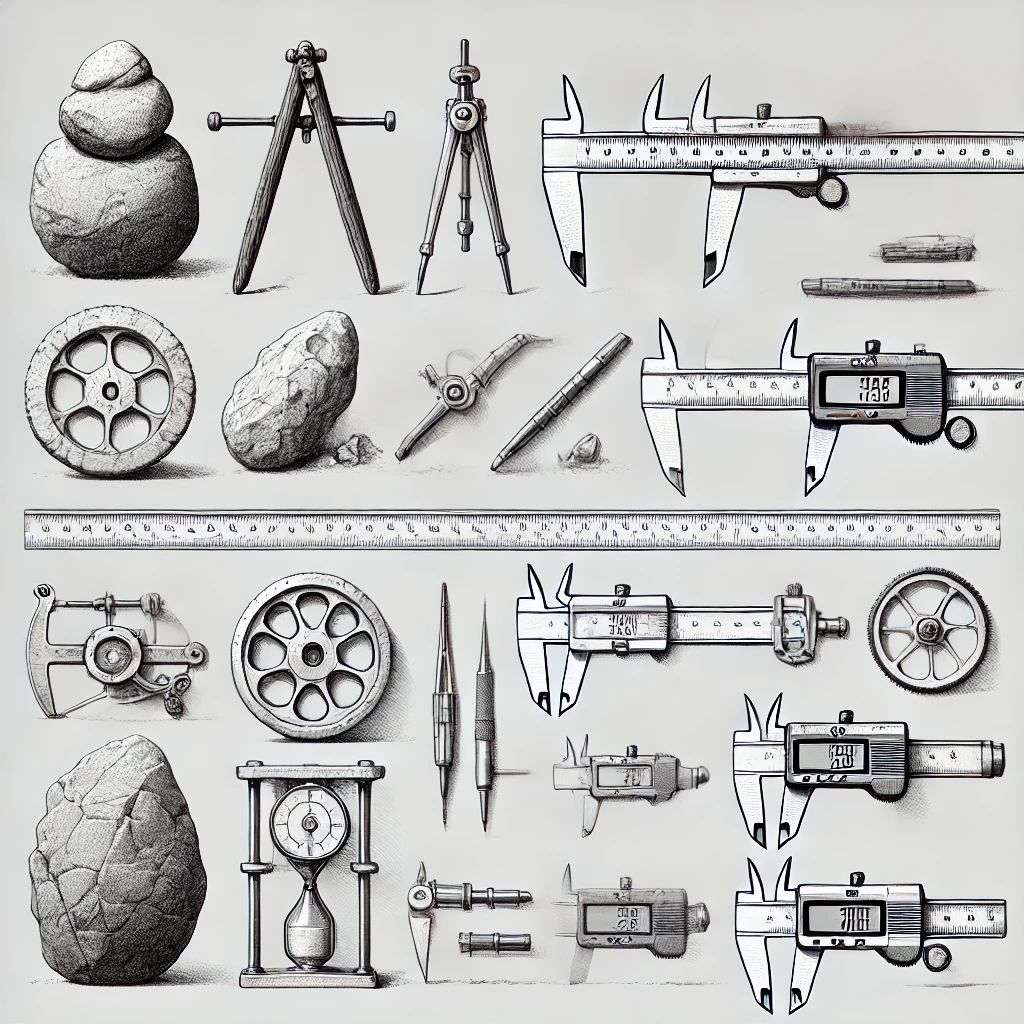
The journey from crude stone tools to instruments capable of measuring at near-atomic scales represents a remarkable progression in human technological capability. This document traces that evolution and explores potential future developments.
Jul 04, 2024
I. Introduction
The journey from crude stone tools to instruments capable of measuring at near-atomic scales represents a remarkable progression in human technological capability. This document traces that evolution and explores potential future developments.
II. Historical Progression Of Measurement Precision
Stone Age (Pre-3000 BCE)
- Rough estimations based on body parts (e.g., hand spans, forearm lengths)
- Natural objects used as reference (e.g., seeds for weight)
Bronze Age (3000-1200 BCE)
- Development of standard units (e.g., Egyptian cubit)
- Creation of marked measuring rods
Iron Age To Middle Ages (1200 BCE - 1500 CE)
- Refinement of standard units
- Introduction of mechanical scales for more precise weighing
Renaissance (1500-1700)
- Development of vernier scales (precision to about 0.1 mm)
- Improved optics leading to early microscopes
Industrial Revolution (1760-1840)
- Invention of micrometer screw gauge (precision to about 0.01 mm)
- Standardization of units across countries
Late 19th - Early 20th Century
- Development of interferometry (precision to wavelengths of light, about 500 nm)
- Discovery of X-rays, enabling finer structural analysis
Mid 20th Century
- Electron microscopy (resolution to about 0.1 nm)
- Invention of atomic clocks for precise time measurement
Late 20th - Early 21st Century
- Scanning tunneling microscopy (resolution to individual atoms, about 0.1 nm)
- Development of femtosecond lasers for ultra-precise time measurements
III. Key Principles In Advancing Measurement Precision
Leveraging Known Constants
- Using wavelengths of light as a standard
- Atomic transitions for time measurement
Amplification Of Small Differences
- Vernier scales
- Electronic amplification in modern sensors
Utilizing Quantum Effects
- Electron tunneling in scanning tunneling microscopes
- Quantumentanglement for enhanced sensitivity
Noise Reduction
- Vibration isolation
- Cryogenic cooling to reduce thermal noise
Indirect Measurement
- Measuring effects or consequences of small phenomena rather than directly measuring them
IV. Current Frontiers Of Precision Measurement
Gravitational Wave Detectors
- Capable of measuring changes in length as small as 10^-19 meters
Atomic Force Microscopy
- Can "feel" individual atoms, achieving resolution of fractions of a nanometer
X-ray Free-Electron Lasers
- Generate ultra-short X-ray pulses to study atomic-level dynamics
Quantum Sensors
- Utilize quantum superposition and entanglement for enhanced sensitivity
V. Approaching Planck Length Measurements
Current Limitations
- Heisenberg Uncertainty Principle fundamentally limits position measurements
- Quantum fluctuations become significant at extremely small scales
Theoretical Approaches
- Quantum non-demolition measurements
- Weak measurements and quantum state reconstruction
Indirect Measurement Strategies
- Studying effects of Planck-scale phenomena on larger, measurable systems
- Cosmological observations of early universe fluctuations
VI. Potential Future Technologies For Ultra-Precise Measurements
Advanced Quantum Metrology
- Utilizing entangled states for enhanced measurement precision
- Potential to approach Heisenberg limit of measurement precision
Spacetime Fluctuation Detectors
- Theoretical devices to measure quantum foam effects
- Could provide indirect evidence of Planck-scale phenomena
Gravity Gradient Sensors
- Ultra-sensitive devices to measure tiny variations in gravitational fields
- Potential applications in detecting small spacetime distortions
Exotic Matter Interfaces
- Theoretical use of exotic states of matter (e.g., strange quark matter) for probing smaller scales
Dimensional Reduction Techniques
- Methods to effectively reduce degrees of freedom in a system, allowing for more precise measurements in remaining dimensions
VII. The Recursion Of Precision: How We Build More Precise Instruments
Iterative Improvement
- Use current best instruments to create slightly better ones
- Example: Using precise lasers to create even more precise optical components
Exploiting New Physical Phenomena
- Discover new effects that allow for more precise measurements
- Example: Transition from mechanical clocks to atomic clocks
Combining Multiple Techniques
- Integrate different measurement methods to overcome individual limitations
- Example: Combining optical and quantum sensors for enhanced precision
Statistical And Data Processing Advances
- Improve precision through better data analysis and noise reduction techniques
- Example: Advanced signal processing in gravitational wave detection
Pushing Theoretical Limits
- Design experiments that approach fundamental physical limits
- Example: Quantum metrology techniques approaching the Heisenberg limit
VIII. Conclusion
The journey from crude stone tools to our current ability to measure near-atomic scales represents a remarkable progression of human ingenuity and scientific understanding. Each advancement in measurement precision has opened new frontiers in science and technology.
As we approach fundamental physical limits like the Planck length, further advancements will likely require revolutionary new concepts and technologies. The pursuit of ever-greater precision not only drives technological progress but also deepens our understanding of the fundamental nature of reality.
The recursive nature of precision improvement — using our best current tools to create even better ones — has been a hallmark of scientific and technological progress. As we continue this journey, we may find that the ultimate limits of measurement are tied to the very fabric of the universe itself.