
The Neuroscience Of Dopamine And Cocaine: A Deep Dive Into Brain Function
Jan 26, 2024
The human brain is an intricate network of billions of neurons, communicating through chemical messengers called neurotransmitters. Among these, dopamine plays a crucial role in reward, motivation, and pleasure. This article explores the complex interplay between dopamine, cocaine, and brain function, delving into the mechanisms of neurotransmission, addiction, and the brain's delicate balance.
1. Dopamine: The Pleasure Molecule
1.1 Basic Dopamine Function
Dopamine is a neurotransmitter primarily associated with the brain's reward system. In a typical neuron-to-neuron interaction:
- Neuron A (the sending neuron) releases dopamine into the synaptic cleft.
- Dopamine molecules traverse the synapse.
- Some dopamine binds to receptors on Neuron B (the receiving neuron), triggering a response.
- Excess dopamine is removed from the synapse by transporter proteins on Neuron A.
This process maintains a balanced level of dopamine in the synapse, crucial for normal brain function.
1.2 The Concept Of "Balance"
In neuroscience, "balance" refers to maintaining optimal neurotransmitter levels for normal brain function. This balance is critical because:
- It prevents desensitization of receptors due to constant stimulation.
- It allows for precise signaling through quick bursts of dopamine followed by clearance.
- It conserves dopamine, which is metabolically expensive to produce.
1.3 Dopamine Release And Reuptake
The brain regulates dopamine levels through complex mechanisms:
- Release is influenced by neural activity, hormones, and environmental stimuli.
- Reuptake is largely automatic, based on transporter proteins' activity.
- Enzymatic breakdown also helps remove dopamine from the synapse.
These processes are fine-tuned by homeostatic mechanisms that adjust based on overall activity levels.
1.4 Dopamine Receptor Binding
When dopamine binds to a receptor:
- It typically remains bound for milliseconds to seconds.
- Unbinding occurs due to thermal energy, conformational changes in the receptor, or competition from other molecules.
- The binding process activates the receptor, while unbinding deactivates it.
- Dopamine isn't consumed in this process but can be reused or broken down after unbinding.
2. Cocaine And Its Effects On The Brain
2.1 Mechanism Of Action
Cocaine primarily affects the dopamine system by:
- Entering the bloodstream and quickly crossing the blood-brain barrier.
- Binding to and blocking dopamine transporters, preventing the reuptake of dopamine.
- Causing a buildup of dopamine in the synapse, leading to intensified and prolonged dopamine signaling.
2.2 Immediate Effects Of Cocaine
The flood of dopamine caused by cocaine leads to:
- Euphoria: Intense feelings of pleasure and excitement.
- Increased Energy: Heightened arousal and wakefulness.
- Heightened Alertness: Enhanced focus and attention.
- Increased Confidence: Often perceived as feeling "extremely clever."
- Rapid Speech and Sociability: Due to overall increased neural activity and disinhibition.
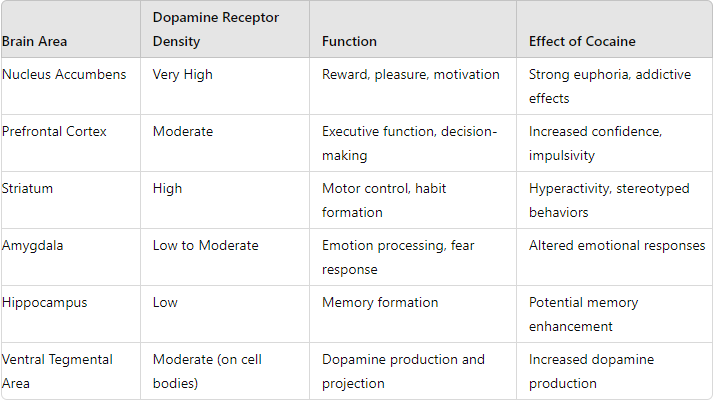
2.3 Cocaine's Impact On Different Brain Regions
Cocaine affects various brain areas differently, based on their dopamine receptor density and function:
3. The Neurobiology Of Addiction
3.1 Development Of Tolerance
With repeated cocaine use:
- The brain adapts to increased dopamine levels by reducing natural dopamine production.
- The number of dopamine receptors may decrease.
- This leads to tolerance, where more cocaine is needed to achieve the same high.
3.2 Withdrawal And Craving
When cocaine use stops:
- The brain experiences a dopamine deficit.
- This results in withdrawal symptoms like fatigue, depression, and intense cravings.
- These symptoms drive the cycle of addiction by motivating further drug use.
3.3 Long-term Brain Changes
Chronic cocaine use can lead to lasting changes in:
- The brain's reward circuit
- Areas responsible for decision-making and impulse control
- Stress regulation systems
These changes contribute to the difficulty of overcoming addiction.
4. Comparative Analysis: Cocaine Vs. Gambling Addiction
While cocaine and gambling addictions share some similarities, they also have distinct differences:
Similarities:
- Both involve the brain's reward system and dopamine.
- Both can lead to tolerance and escalation of behavior.
- Both can cause lasting changes in brain structure and function.
- Both can result in compulsive behavior and loss of control.
- Both can have severe negative impacts on a person's life.
Differences:
- Cocaine directly alters brain chemistry, while gambling affects it indirectly.
- Cocaine has physical withdrawal symptoms, while gambling withdrawal is primarily psychological.
- Cocaine addiction involves a specific substance, while gambling is a behavioral addiction.
- The immediate health risks of cocaine use (e.g., overdose) are generally more severe than those of gambling.
5. The Complexity Of Neurotransmission
5.1 Dynamic Range Of Signaling
The brain's ability to modulate neurotransmitter levels allows for appropriate responses to different situations:
- Low arousal states (e.g., rest) need minimal signaling.
- Moderate arousal (e.g., normal daily activities) requires intermediate signaling.
- High arousal states (e.g., stress, excitement) need intense signaling.
5.2 Factors Influencing Dopamine Release
Dopamine release can be affected by:
- Neural activity: More action potentials lead to more release.
- Environmental stimuli: Novel or rewarding experiences can increase release.
- Internal states: Stress or hunger can modulate release.
- Other neurotransmitters: Some can enhance or inhibit dopamine release.
- Drugs: Some substances directly affect release mechanisms.
6. Neuroplasticity And Potential Interventions
6.1 Brain Plasticity
The brain's ability to form new neural connections and adapt to experiences plays a crucial role in both the development of addiction and recovery.
6.2 Potential Interventions
Various approaches may help modulate brain function, though these should only be pursued under medical supervision:
- Pharmacological treatments targeting specific neurotransmitter systems
- Cognitive-behavioral therapies to reshape thought patterns and behaviors
- Mindfulness and meditation practices to enhance prefrontal cortex function
- Neurofeedback techniques to train specific brain activity patterns
Conclusion
The intricate dance of neurotransmitters, particularly dopamine, underlies much of our experienced reality, from everyday pleasures to the grip of addiction. Understanding these mechanisms not only illuminates the workings of the brain but also paves the way for more effective treatments for addiction and other neurological disorders. As research progresses, our grasp of these complex systems continues to evolve, promising new insights and potential therapies for the future.