
The Quantification Of Attraction: Examining The 'Relationship Score' Theory
We'll examine the implications, criticisms, and potential applications of this approach, while also considering alternative frameworks for understanding relationship dynamics.
Feb 20, 2024
Introduction
In the complex world of human relationships, there's an ongoing debate about the extent to which attraction and compatibility can be quantified. This article explores the controversial concept of "relationship scores" - a theory suggesting that individuals subconsciously assign numerical values to potential partners based on various attributes. We'll examine the implications, criticisms, and potential applications of this approach, while also considering alternative frameworks for understanding relationship dynamics.
The 'Relationship Score' Theory
Core Concepts
The 'relationship score' theory posits that individuals evaluate potential partners based on a combination of attributes, each contributing to an overall "score." These attributes may include:
- Physical appearance
- Personality
- Financial stability
- Social status
- Health
- Intelligence
- Emotional connection
- Shared interests and values
Proponents of this theory argue that people tend to form relationships with others who have similar overall scores, leading to the concept of "leagues" in dating.
Theoretical Implications
Score Differentials
The theory suggests that significant score differences between partners can lead to imbalances in the relationship.
Dynamic Scores
Scores can change over time due to personal growth, life experiences, and changing priorities.
Subjectivity
Scores vary between individuals and cultures, reflecting personal preferences and societal values.
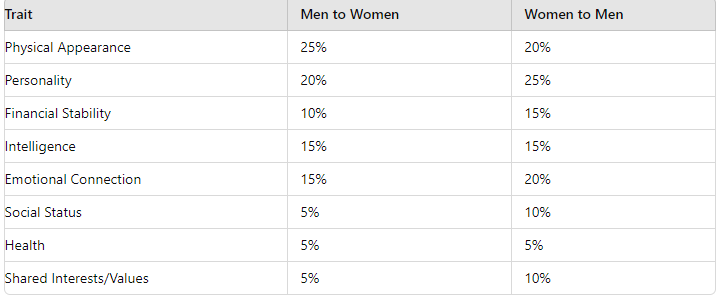
Estimated Trait Weights
Here's a rough estimate of how different traits might be weighted in heterosexual relationships, based on societal trends:
Scientific Perspectives
While the 'relationship score' theory isn't a formal scientific model, it relates to several established concepts in psychologyand sociology:
Assortative Mating
People tend to pair up with partners who are similar to them in various attributes [1].
Social Exchange Theory
Relationships are formed through a process of cost-benefit analysis [2].
Mate Value
Evolutionary psychologists use this term to describe an individual's overall desirability as a mate, similar to the 'score' concept [3].
Criticisms And Controversies
The 'relationship score' theory has faced significant criticism:
- Reductionism: Critics argue that reducing human complexity to numerical scores oversimplifies the nuances of attraction and compatibility [4].
- Ethical Concerns: There are worries that this approach could promote objectification and reinforce harmful stereotypes or social hierarchies [5].
- Neglect of Qualitative Factors: The theory may undervalue critical aspects of relationships that are difficult to quantify, such as emotional connection and shared experiences [6].
- Cultural Bias: The importance of different attributes varies significantly across cultures, making a universal 'scoring' system problematic [7].
Alternative Frameworks
Given the limitations of the 'score' approach, researchers and relationship experts have proposed various alternative frameworks for understanding relationship dynamics:
- Attachment Theory: Focuses on how early relationships shape adult attachment styles [8].
- The Triangular Theory of Love: Proposes that love has three components: intimacy, passion, and commitment [9].
- The Five Love Languages: Suggests that people express and receive love in different ways [10].
- Gottman's Seven Principles: Based on extensive research, these principles focus on behaviors that predict relationship success [11].
Practical Applications And Considerations
Despite its controversies, elements of the 'relationship score' concept have found their way into practical applications:
- Dating Apps: Many use algorithms that match users based on compatibility scores derived from various attributes [12].
- Relationship Counseling: Some therapists use frameworks that assess compatibility across multiple dimensions, though usually in a more nuanced way than simple scoring [13].
However, it's crucial to approach these applications with caution, recognizing their limitations and potential biases.
Conclusion
The 'relationship score' theory offers an intriguing, if controversial, lens through which to examine human attraction and relationship formation. While it may provide some insights into general patterns of mate selection, it's essential to recognize its limitations. Relationships are complex, multifaceted entities that often defy simple quantification.
As we continue to study and understand human relationships, it's crucial to balance quantitative approaches with qualitative insights, always keeping in mind the rich complexity of human emotions and interactions. Future research in this field will likely focus on more holistic models that can account for both measurable attributes and the ineffable qualities that make each relationship unique.
References
[1] Buss, D. M. (1985). Human mate selection. American Scientist, 73(1), 47-51.
[2] Emerson, R. M. (1976). Social exchange theory. Annual Review of Sociology, 2(1), 335-362.
[3] Fisher, H. E., Aron, A., & Brown, L. L. (2006). Romantic love: a mammalian brain system for mate choice. Philosophical Transactions of the Royal Society B: Biological Sciences, 361(1476), 2173-2186.
[4] Finkel, E. J., Eastwick, P. W., Karney, B. R., Reis, H. T., & Sprecher, S. (2012). Online dating: A critical analysis from the perspective of psychological science. Psychological Science in the Public Interest, 13(1), 3-66.
[5] Heino, R. D., Ellison, N. B., & Gibbs, J. L. (2010). Relationshopping: Investigating the market metaphor in online dating. Journal of Social and Personal Relationships, 27(4), 427-447.
[6] Joel, S., Eastwick, P. W., & Finkel, E. J. (2017). Is romantic desire predictable? Machine learning applied to initial romantic attraction. Psychological Science, 28(10), 1478-1489.
[7] Hatfield, E., & Rapson, R. L. (1996). Love and sex: Cross-cultural perspectives. Allyn & Bacon.
[8] Hazan, C., & Shaver, P. (1987). Romantic love conceptualized as an attachment process. Journal of Personality and Social Psychology, 52(3), 511.
[9] Sternberg, R. J. (1986). A triangular theory of love. Psychological Review, 93(2), 119.
[10] Chapman, G. (1992). The Five Love Languages: How to Express Heartfelt Commitment to Your Mate. Northfield Publishing.
[11] Gottman, J. M., & Silver, N. (1999). The seven principles for making marriage work. Crown Publishers.
[12] Finkel, E. J., Eastwick, P. W., Karney, B. R., Reis, H. T., & Sprecher, S. (2012). Online dating: A critical analysis from the perspective of psychological science. Psychological Science in the Public Interest, 13(1), 3-66.
[13] Bradbury, T. N., & Karney, B. R. (2004). Understanding and altering the longitudinal course of marriage. Journal of Marriage and Family, 66(4), 862-879.