01 / Before the ingredient list
Appearance alone does not identify a pigment mechanism.
Post-acne marks, sun-associated lentigines and melasma can all appear darker than surrounding skin, but have different causes and responses. Persistent inflammation, light exposure, hormonal influences and other conditions contribute through distinct mechanisms. Photographic resemblance alone cannot distinguish them.[1]
“Advanced” is a marketing description. Evaluation requires a plausible target and human evidence for the finished formulation in the relevant condition.
Pigment synthesis, transfer and turnover
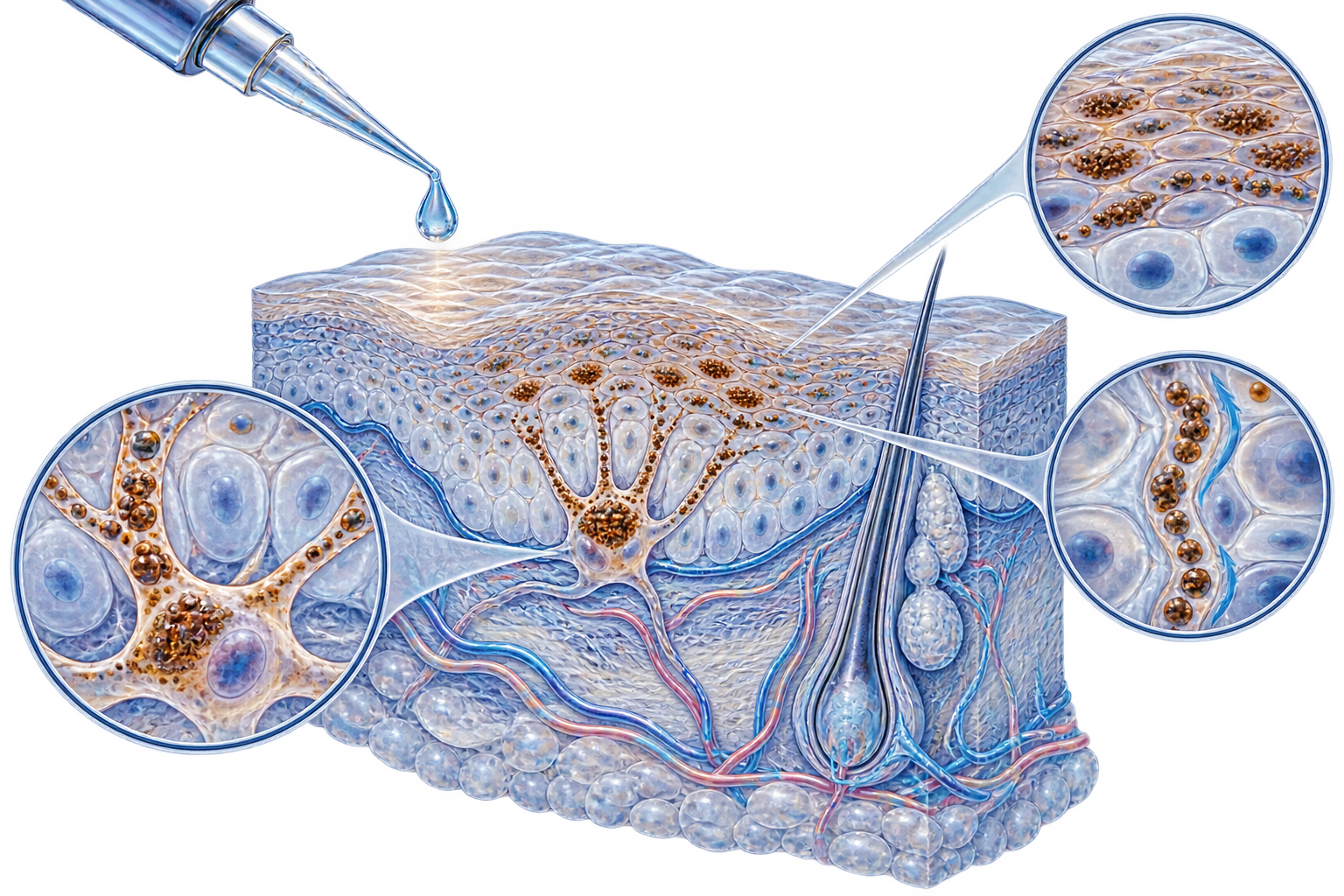
A melanocyte produces pigment in melanosomes and transfers them to surrounding keratinocytes, which move toward the skin surface.
Follow a mechanism
Tyrosinase participates in melanin synthesis. Inhibiting an enzyme in a laboratory is an early finding; penetration, irritation and clinical outcomes still matter.
02 / Production, transfer, turnover
Melanin moves through a cellular system.
Melanocytes manufacture melanin in organelles called melanosomes. Pigment is transferred to surrounding keratinocytes, the cells that make up most of the epidermis. Visible pigmentation therefore depends on production, distribution and removal as skin renews. Reducing one step may help in a particular condition, but cannot automatically correct every cause of discoloration.
Tyrosinase-targeting ingredients affect melanin synthesis; others influence melanosome transfer or epidermal turnover. Hakozaki and colleagues studied niacinamide in transfer experiments and human pigmentation assessments, rather than assuming direct destruction of pigment or melanocytes.[2]
Clinical relevance depends on stability, penetration and tolerability at the delivered concentration. A purified ingredient’s evidence does not establish the performance of every product containing it; vehicles, combinations and use conditions can alter outcomes.
03 / What a trial can establish
Efficacy depends on condition and formulation.
Randomized trials have compared topical tranexamic acid with hydroquinone for melasma. A small trial in women supports only formulation- and condition-specific conclusions. The rationale involves plasmin-related signaling and interactions between inflammation and pigmentation, rather than straightforward exfoliation.[3]
Oral tranexamic acid produces a different exposure with systemic risks and evidence. Results for topical formulations do not establish the effects of oral exposure. Likewise, a prescription combination cream cannot establish efficacy for an unrelated over-the-counter serum.
A useful result
A defined population, comparable control, standardized outcome and clear treatment duration show what changed and under what conditions.
An incomplete result
An uncontrolled photograph or a claim of “clinically proven ingredients” leaves the finished formula, comparison and size of benefit unclear.
Study sponsorship, small samples, short follow-up and uncertain durability affect confidence. A statistically detectable change in a pigment score may not be a dramatic visible improvement. Relapse also matters when the underlying condition, such as melasma, can persist.
04 / Irritation and exposure
Irritation can work against the goal.
Inflammation can leave post-inflammatory hyperpigmentation, especially in darker skin tones. Combining several irritating products can therefore create more of the very discoloration associated with post-inflammatory pigmentation. A burning sensation is not evidence that pigment is being successfully removed. Acne or eczema can continue to generate inflammatory signals while post-inflammatory marks remain.[1]
Ultraviolet exposure can sustain pigmentation, and visible light can aggravate some conditions. AAD discusses tinted sunscreen containing iron oxide for dark spots in darker skin tones. Shade and protective clothing reduce exposure alongside sunscreen.[1]
Sources & further reading
Follow the evidence.
- 01
- 02Hakozaki et al. (2002): Niacinamide, pigmentation and melanosome transfer
Laboratory and human studies; formulation-specific evidence.
- 03Atefi et al. (2017): Topical Tranexamic Acid Compared with Hydroquinone in Melasma
Randomized study in 60 women; not evidence for every pigment condition.
- 04